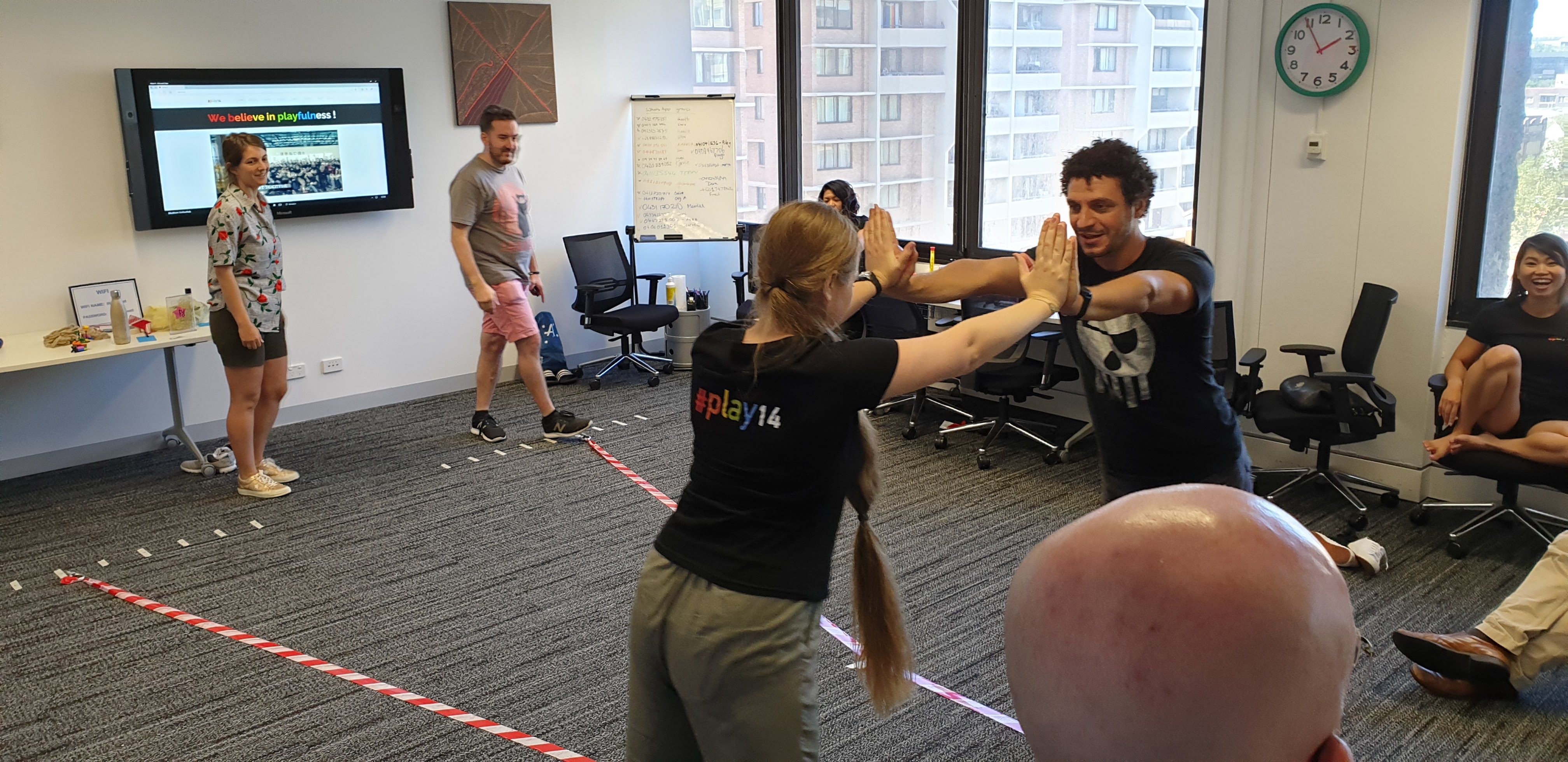
Crevasse
Collaborate as a pair to avoid falling into the crevasse
This game may look simple, but it is trickier than it seems. It is a good game to demonstrate teamwork, rapid decision making and learning.
It is a physical game, so check beforehand how many people may not want to take part. It requires an even number of players: with an odd number, the facilitator can pair up with the last person, or that person can join the facilitator to take pictures and learn how to facilitate the game.
It works better with larger groups: more pairs moving through the "system" creates more interactions and more randomness.
Setup
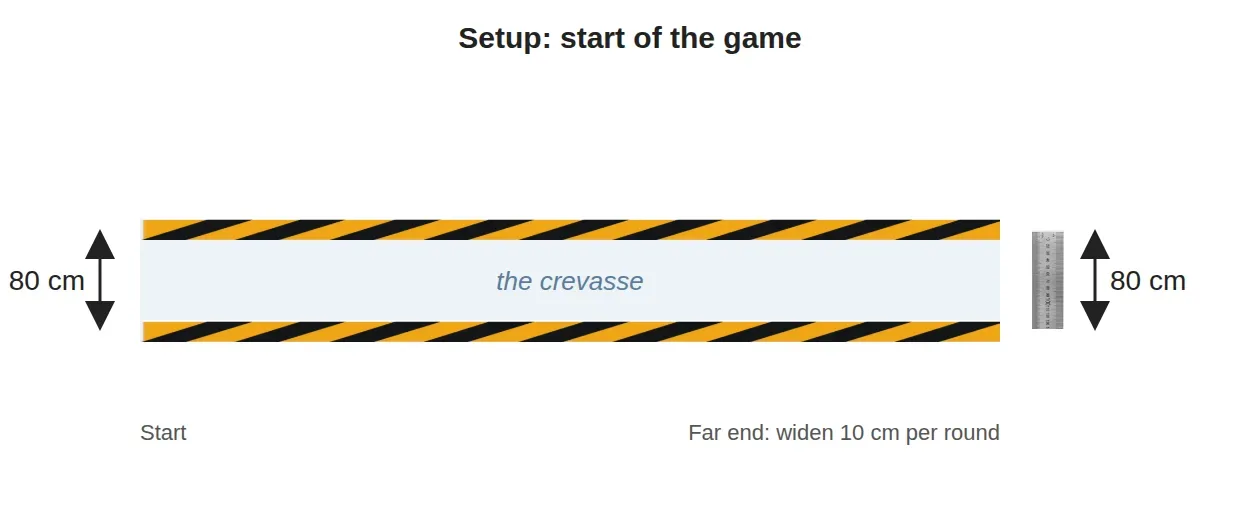
Use yellow & black or red & black hazard tape to draw the two edges of the "crevasse" on the floor (any packing tape will do if you have none), and fix it to the floor with sticky tape.
- At the start, both ends of the crevasse are 80 cm wide.
- Place a ruler (or tape measure) at the far end, which is the end that will move, so you can widen the crevasse in steady increments.
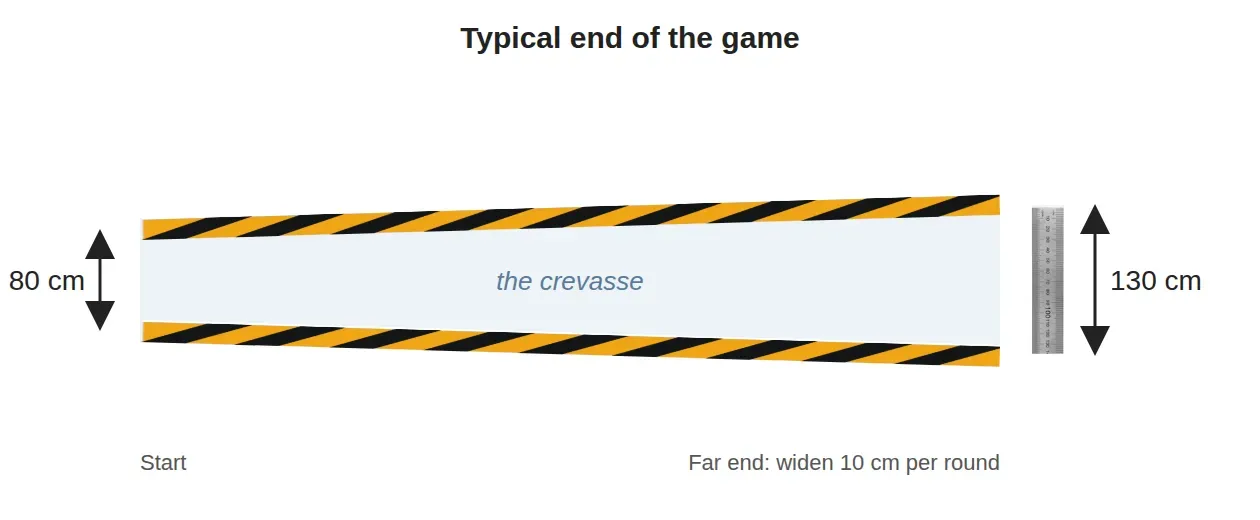
- By the end of the exercise, the crevasse usually looks like a funnel: still 80 cm wide at the start, around 130 cm wide at the far end.
How to play
The goal is to move along the crevasse with your partner.
- Each pair stands on either side of the crevasse, facing each other, and touches hands.
- Pairs move to the end of the crevasse without stepping into it. If either partner steps inside the crevasse, the pair is eliminated.
- Once all pairs are through, the facilitator widens the far end of the crevasse by 10 cm.
- After the first round, ask each pair to estimate how far along the crevasse they think they will get.
- Each pair traverses the crevasse again.
- Repeat until only one pair remains.
After each passage, ask the group what they noticed as the crevasse got wider, for example:
- Did you look at other pairs and what they were doing?
- Did you try to slow things down?
- Did you do any planning?
- Did you consider going back?
Debrief
Since the exercise is debriefed after each passage, the final debrief can focus on the bigger picture:
- What did you learn?
- How does this apply to your day-to-day work?
- Are there any parallels with your team or organisation?
- Was there anything you didn't think of?
- Did anyone double back?
- Did everyone hit their target estimate? Who exceeded it? Who missed it?
- Now that you've finished, what would you take into account if you had to re-estimate?
Credits
Adapted from La Crevasse on coach-agile.com.